· 8-minute read
Daily standup questions

By
Joe Corcoran
Founder of Clarvelo
The three classic standup questions, better questions grouped by purpose, standup formats to try and how to reset a standup that has stopped being useful.
The classic daily standup questions are: What did I do yesterday? What will I do today? Is anything blocking me? They are a simple way to share progress and spot problems in about 15 minutes. Many teams now adjust them so the standup focuses on the team’s goal and on getting help, rather than on individual status updates.
This guide covers the three standard questions, better standup questions grouped by purpose, a few standup formats to try and what to do when your standup has stopped being useful.
The 3 questions for daily standup
- What did I do yesterday? A short update on what moved forward.
- What will I do today? The plan for the next day of work.
- Is anything blocking me? Anything that slows the work down and needs help from someone else.
These questions became popular with Scrum, where the daily standup is called the Daily Scrum. Earlier versions of the Scrum Guide listed them as an example. The 2020 Scrum Guide removed them. It now describes the Daily Scrum as a 15-minute event where the developers inspect progress toward the Sprint Goal and adjust their plan, and it lets the team choose any structure that does that.
The three questions still work well for many teams, especially new ones. Their weak point is that they invite a status report. Each person reports their tasks to the team lead, and nobody connects the updates to a shared goal. Blockers get mentioned but not solved.
Better standup questions, by purpose
Choose a few questions that fit what your team needs right now. You do not need all of them, and you can change them when the team’s situation changes.
Questions about the team goal
- What did we move forward yesterday toward our sprint goal?
- What is the most important thing for the team to finish today?
- Are we still on track for the goal? If not, what needs to change?
- Is there anything we should stop working on so we can finish something else?
Questions about blockers and help
- What is slowing you down?
- What are you waiting on, and from whom?
- Who could use help today?
- Is there a decision we need to make so work can continue?
- What risk should the team know about before it becomes a blocker?
Questions for walking the board
Some teams skip the round robin and go through the work instead, starting with the items closest to done.
- What does this item need to get to done?
- Has anything been in progress longer than expected?
- Is anyone working alone on something that would go faster with a pair?
- Do we have too much work in progress?
Questions for remote and async standups
When people work in different time zones, a written standup can replace or support the meeting. Keep the questions short so the answers are quick to read.
- What did you finish since your last update?
- What are you focusing on next?
- Do you need anything from anyone?
- Is there anything the team should discuss live this week?
Questions for the person running the standup
- Did we finish within 15 minutes?
- Did every blocker get an owner or a follow-up?
- Did people talk to each other, or only report to me?
- Is there a topic that needs its own meeting instead of a longer standup?
Stand-up meeting formats to try
- Round robin. Each person answers the same questions in turn. It is simple and familiar, but it can become a series of status reports.
- Walk the board. Go through the work items from closest to done to newest. This keeps the focus on finishing work rather than on who is busy.
- Goal first. Start with the sprint goal, ask whether the team is on track, then discuss only what affects the goal.
- Blockers only. Share updates in writing beforehand and use the meeting only for blockers and decisions.
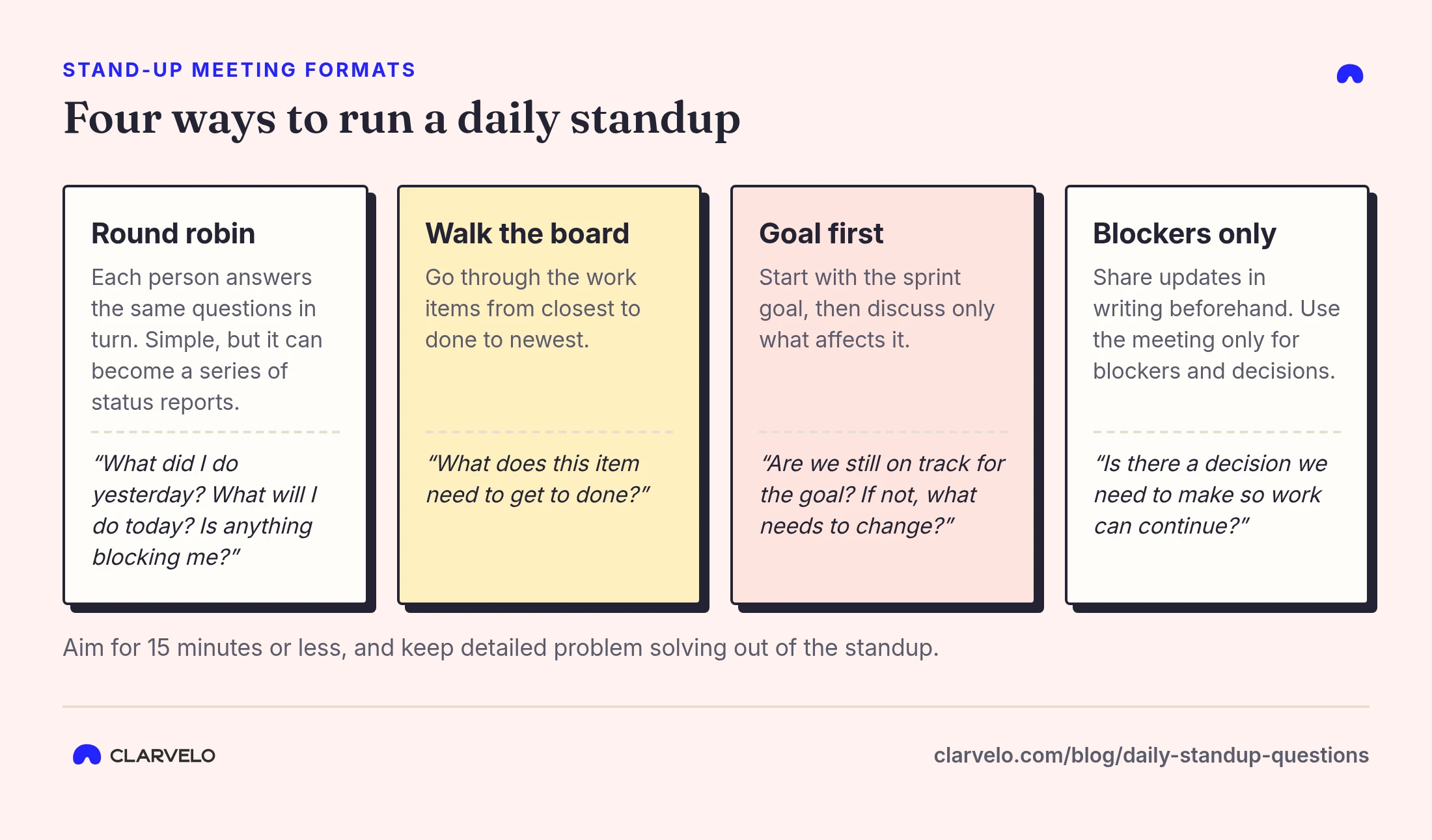
Whatever the format, keep detailed problem solving out of the standup. When a topic needs more than a minute, name who needs to talk about it and continue after the standup with only those people.
Signs your standup needs a reset
- It regularly takes longer than 15 minutes.
- People report to the manager instead of talking to each other.
- The same blockers come up for several days in a row.
- People stop listening while they wait for their turn.
- Nobody can say how the updates connect to the team’s goal.
- People skip it, or join with their cameras off and their attention elsewhere.
Changing the questions can help. If the problems keep coming back, the team needs to agree together on what the standup is for. A change the team chooses tends to last longer than a new format introduced by one person.
How to reset your standup with your team
Clarvelo’s Standup Reset workshop is a 40-minute session for 2 to 10 people whose standups have become stale, too long or low-value. It has three steps:
- Start, Stop, Continue (20 minutes). Everyone names what the standup should start doing, what it should stop doing and which useful habits to keep.
- Theme Sort (10 minutes). The group sorts similar items into themes with plain names and keeps important outliers visible.
- Blind Vote (10 minutes). Everyone votes privately on the changes that would give back the most time or clarity.
The session ends with one change to try in the next cycle and a point when the team will check whether it helped. The AI facilitator asks the questions, keeps time and runs the vote, so the scrum master or team lead can take part instead of running the discussion about their own meeting. Guests join from a link.
Frequently asked questions
What are the 3 standup questions?
The three classic standup questions are: What did I do yesterday? What will I do today? Is anything blocking me? Each person answers them briefly so the team can see progress and spot problems.
Are the three questions still part of Scrum?
The 2020 Scrum Guide no longer lists them. It describes the Daily Scrum as a 15-minute event where the developers inspect progress toward the Sprint Goal and adapt their plan. Teams can still use the three questions if they help.
How long should a daily standup be?
Aim for 15 minutes or less. If topics need more time, note who needs to discuss them and continue after the standup with only those people.
What should you say in a standup meeting?
Keep it short and useful to the team. Say what you moved forward, what you will focus on next and whether anything is blocking you or anyone else. Mention a risk early, before it becomes a blocker.
What questions work for an async standup?
Use short questions that are quick to read: What did you finish since your last update? What are you focusing on next? Do you need anything from anyone? Is there anything the team should discuss live?
How do you fix a boring standup?
Change the focus from individual status to the team goal, try walking the board, and move problem solving out of the meeting. If the problems keep coming back, run a short session where the team decides together what to start, stop and continue.
Make your standup useful again
If your standup has drifted, let the team decide how to fix it. Clarvelo’s Standup Reset guides 2 to 10 people through Start, Stop, Continue, Theme Sort and Blind Vote in 40 minutes, and ends with one change to try.
Ready to reset your standup? Sign up and start a Standup Reset. Bring the team. Clarvelo will run the session.