· 10-minute read
How to run a product vision workshop

By
Joe Corcoran
Founder of Clarvelo
A product vision workshop helps a team agree where a product is heading and what matters first. Learn the 80-minute agenda, the three exercises and how to turn the result into a product vision statement.
A product vision workshop is a session where the people who shape a product agree on where it is heading. In about 80 minutes, the group names its hopes and concerns, describes what success would look like a few years from now, and ranks the themes that should guide the work. The result is a shared direction and a short list of what matters first.
Many teams agree on how hard to work long before they agree on where they are going. Product wants one thing, engineering assumes another, and a founder carries a third version in their head. Everyone is busy, and the roadmap slowly fills with work that pulls in different directions. A product vision workshop gives those views one place to meet.
If you want the facilitation handled for you, Clarvelo’s Product Vision Alignment workshop runs the same 80-minute sequence for 2 to 10 people. The AI facilitator collects everyone’s input, guides each step and records the priorities the group chose.
What is a product vision?
A product vision describes the future your product is trying to create. It says who the product is for, what changes for them, and why that change matters. It looks further ahead than a roadmap, often two to five years, and it does not list features. A good vision helps people make everyday decisions without asking for permission each time.
A product vision is different from a product strategy. The vision is the destination. The strategy is the plan for getting there: which customers to focus on, which bets to make first, and what to leave out. The workshop below helps a team agree on the destination and the first priorities. Detailed planning can follow in a separate session.
When to run a product vision workshop
- When a new product or a major new direction is about to start
- When a team has grown quickly and new people bring different ideas of what the product is for
- When roadmap discussions keep going in circles because people disagree about the goal behind the tasks
- After a big change, such as a new market, a new leadership team or a major customer loss
- Once a year, to check that the vision still matches what the team has learned
A vision workshop is less useful when the direction is already fixed and nobody in the room can influence it. In that case, a planning session or a clear announcement will serve the team better.
Who should join
Invite between 2 and 10 people who shape the product or depend on its direction. A typical group includes the product manager, a founder or senior leader, an engineering lead, a designer and someone who talks to customers often, such as sales or support. Include the person who will make the final call on the vision. Different roles notice different hopes and risks, so a mix of views makes the result stronger.
What to prepare
- The product or product area the vision should cover
- Any existing vision, mission or strategy documents, even if they are out of date
- What you know about customers: research notes, interview quotes, usage data or feedback from sales and support
- The decision this session should inform, such as the next roadmap, a funding plan or a team reorganization
- 80 minutes without other agenda items
Product vision workshop agenda
The agenda has three steps. Each step uses the output of the one before, so the group moves from honest concerns to a shared picture of success, and then to clear priorities.
- 25 minutes: Hopes and Fears, to surface what people want from the product and what worries them
- 35 minutes: Newspaper Headline, to describe a believable future success in concrete terms
- 20 minutes: Priority Map, to rank the themes that should shape the vision
Step 1: Hopes and fears (25 minutes)
Start by naming the product and the time frame, for example “our scheduling product, three years from now.” Then ask each person to write down their hopes for the product and their fears about its direction. Hopes describe the outcomes people want to see. Fears name the risks, trade-offs or failure modes they want discussed early.
Give people a few minutes to write on their own before anyone shares. This gives quieter people time to think, and it stops the most senior voice from setting the tone. Then read the items back, group similar ones and look for patterns. A hope that several people share is a strong candidate for the vision. A fear that several people share is a risk the vision should address.
What would make you proud of this product in three years? What would worry you if we kept going exactly as we are?
Step 2: Write the future headline (35 minutes)
Now ask the group to imagine that the product has succeeded. A newspaper or trade magazine is writing about it. What does the headline say? Use the hopes from the first step as raw material, and keep the main fears in view so the story stays believable.
Build the article in parts. Each part makes the vision a little more concrete:
- Headline: the biggest change the product has made, in one line
- Subheading: one or two sentences on who benefits and how
- Key details: three to five facts that would make the success believable, such as a customer outcome, a number or a market position
- Quotes: what a customer, a team member and a partner would say about the product
“Small clinics stop losing appointments.” Two years after launch, community clinics using the product see fewer missed appointments, and front-desk staff spend their mornings with patients instead of on the phone.
If people write separate headlines, compare them before you merge. The differences are useful. One headline might focus on customer outcomes and another on revenue. Name those differences out loud, because they often explain the disagreements the team has been having in roadmap meetings.
Step 3: Prioritize the themes (20 minutes)
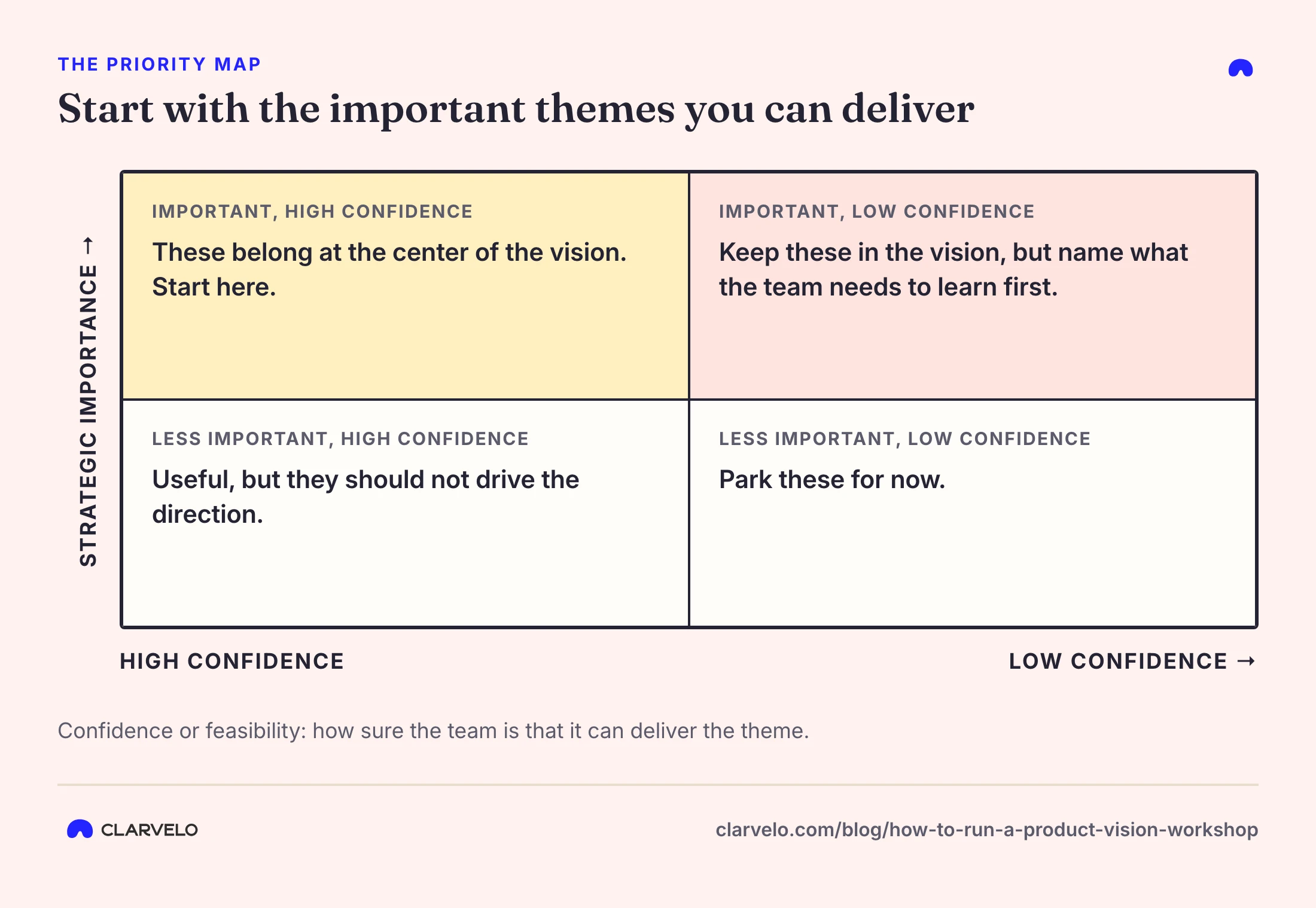
Pull the themes out of the headlines and details. These might be “clinics run with fewer staff,” “patients book without calling” or “the product works for multi-site groups.” Then place each theme on a simple two-by-two grid. One axis is strategic importance. The other is confidence or feasibility: how sure the team is that it can deliver this.
- Important, high confidence: These belong at the center of the vision. Start here.
- Important, low confidence: Keep these in the vision, but name what the team needs to learn first.
- Less important, high confidence: Useful, but they should not drive the direction.
- Less important, low confidence: Park these for now.
Use the last few minutes to close. Read back the top priorities in order and ask whether anything is missing or in the wrong place. Ask what evidence would change the ranking and write that down as an assumption to check. Then name the next step: who will draft the vision statement, and where the result will be used.
Turn the workshop into a product vision statement
The workshop gives you the material. A vision statement turns it into something short enough to repeat. One simple format works well:
For [who the product is for], who [need or problem], [product] will [the change it makes]. We will know it is working when [a signal you can observe].
For small community clinics, who lose time and income to missed appointments, our product will make booking and reminders simple enough that front-desk staff can focus on patients. We will know it is working when clinics see fewer missed appointments within their first three months.
Ask one person to draft the statement within a few days and share it with the group for comments. Then use it. Bring it to roadmap reviews and planning sessions, and check new ideas against it. If the next step is setting goals for the quarter, an OKR setting workshop can turn the top priorities into measurable objectives. If the team has many feature ideas competing for attention, a feature prioritization workshop can help compare them.
Common product vision workshop mistakes
- Writing a slogan instead of a direction. “Delight our customers” could describe any product. Name who the customers are and what changes for them.
- Listing features. A vision describes the outcome you want. Features belong in the roadmap.
- Letting the most senior person speak first. Collect written input before discussion so everyone’s view is visible.
- Skipping the fears. A vision that ignores the team’s real concerns is hard to believe and easy to ignore.
- Ending without priorities. A shared headline is a good start, but the team also needs to know what to focus on first.
- Never revisiting it. Check the vision at least once a year, or after a big change in the market or the team.
How Clarvelo’s AI facilitator runs a product vision workshop
Clarvelo’s Product Vision Alignment workshop is an 80-minute session for 2 to 10 people. It has three phases: Hopes and Fears for 25 minutes, Newspaper Headline for 35 minutes and Priority Map for 20 minutes. The output of each phase becomes the input to the next.
Hopes and Fears
The AI facilitator confirms the product and direction the group wants to discuss. It asks each person for hopes and fears, prompts for more detail when an answer is vague, and groups similar items into themes. It then summarizes what the group produced before moving on.
Newspaper Headline
The AI facilitator carries the hopes and fears into the next step. It guides the group through the headline, the subheading, the key details and the quotes. It asks what would make the success believable, so the story stays close to what the team knows.
Priority Map
The AI facilitator pulls the themes from the headline and asks the group to place each one by strategic importance and by confidence or feasibility. It asks for the reasoning behind the top items. To close, it reads back the priority order, asks what evidence would change it and names the next conversation or document the result should feed.
Everyone can take part
Guests join from a link and do not need an account. The person who organized the session can contribute as a participant instead of running the workshop. This matters in a vision workshop, because the organizer is often the product manager or founder whose view the team most needs to hear. The AI facilitator guides the process, and the team supplies the context and makes the final decisions.
Frequently asked questions
What is a product vision workshop?
A product vision workshop is a structured session where the people who shape a product agree on where it is heading. The group shares hopes and concerns, describes what future success would look like, and ranks the themes that should guide the work.
How long does a product vision workshop take?
Plan for about 80 minutes. Spend around 25 minutes on hopes and fears, 35 minutes describing a future success and 20 minutes prioritizing the themes. If you have less time, shorten the first step and protect the prioritization, because the ranked themes are the main output.
Who should attend a product vision workshop?
Invite 2 to 10 people who shape the product or depend on its direction. This usually includes the product manager, a founder or senior leader, an engineering lead, a designer and someone who talks to customers. Include the person who will make the final call.
What is the difference between a product vision and a product strategy?
The product vision describes the future the product is trying to create and who it is for. The product strategy is the plan for getting there, including which customers to focus on and which bets to make first. Agree on the vision first, then plan the strategy.
What makes a good product vision?
A good product vision names who the product is for, what changes for them and why it matters. It is short enough to remember and specific enough to guide decisions, and it looks a few years ahead. It describes outcomes and leaves features to the roadmap.
How often should you revisit your product vision?
Review it at least once a year. Also review it after a big change, such as a new market, new leadership or a major shift in what customers need. The vision can stay stable while the strategy and roadmap change more often.
Agree on where your product is heading
Clarvelo’s Product Vision Alignment workshop guides 2 to 10 people from hopes and fears to a shared future headline and a ranked set of priorities. Guests join from a link, and the AI facilitator keeps time, carries the work between phases and records what the team chose to focus on.
Need your team to agree on the direction before the next roadmap? Sign up and start a Product Vision Alignment session. Bring the product and the people who shape it. Clarvelo will run the workshop process.