· 12-minute read
LLM council in production: how we synthesize group input with three models from three regions

By
Joe Corcoran
Founder of Clarvelo
We run an LLM council in production to synthesize what a group said in a live workshop: three models from three regions, a mediator, about $0.06 per run, and a fallback when anything fails.
An LLM council sends one question to several language models, lets them see each other's work, and asks one more model to write the final answer. Andrej Karpathy made the pattern popular with his open-source LLM Council, which he describes as "a fun Saturday hack" and says he will not support. So most people who search for "LLM council" want to know one thing: does the idea hold up for real work?
It can, if you change it for the job it has to do. At Clarvelo we run an LLM council in production as one of three ways to synthesize what a group of people said during a live workshop. This post explains how it works, what it costs per run, how it fails, and what changes when the input comes from a room full of people instead of one person's question.
What is an LLM council?
An LLM council is a group of language models that work on the same input, followed by a step that combines their outputs into one answer. Karpathy's version has three stages. First, each council model answers the user's question on its own. Second, each model reads the other answers with the authors' names hidden and ranks them for accuracy and insight. Third, a "chairman" model reads everything and writes the final response. His default council uses four frontier models from four different labs.
Other projects have built on the same shape. llm-council.dev is an open-source tool with the same three stages. It combines the anonymous rankings with a Borda count (a ranked-voting method that gives points by position), reports cost per model and per stage, and can return a pass, fail or unclear verdict for a CI pipeline. Paid council apps and Hugging Face demos follow the same pattern.
Skill versions for Claude Code are popular too. They run one model as several advisors with different thinking styles, such as a contrarian, and then a chairman role writes the verdict. That is closer to our second strategy below, one model in three roles, than to Karpathy's council of different models.
All of these tools take one person's question and return one answer to that person. None of the projects that rank for "LLM council" today takes input from a group of people who are working together at the same time. That is the case we built for.
What changes when the input comes from a group
In a Clarvelo workshop, an AI facilitator opens an exercise: it asks the room a question, and each participant submits an answer. The facilitator can ask for a synthesis of those answers whenever it needs one. Most often it asks once, when an exercise ends, for a summary of what the group said before it moves the workshop on. The input to that synthesis is very different from a chat question.
There is no single right answer to rank. The input is a set of short answers from different people, often to an open question such as what slowed the team down in the last sprint. The useful output is a map of that input: the themes, the real disagreements, the view only one person holds, and what nobody mentioned. Council members do not compete to give the best answer. Each one reads the same evidence through a different lens. For this reason our council has no peer-ranking stage.
Counts matter. The synthesis receives the number of people in the exercise and the number who actually submitted, plus a short note about scope, for example that someone left before they answered. With these counts, the briefing can say "four of six people" and does not present a partially completed exercise as the view of the whole group. Our multi-user AI facilitation protocol defines how each participant's outcome in an exercise is recorded (submitted, pending or left).
People also talk outside the exercise. Clarvelo has two lanes: counted answers in the exercise, and comments in open chat. Synthesis gets both, but treats chat comments as secondary context. A comment can explain an answer. It should not outvote one.
The council writes its synthesis for the AI facilitator: a briefing that the facilitator reads before it speaks to the room. The briefing goes to a live insights area that later syntheses can replace, and it is never exported as a decision.
In Karpathy's design the chairman's answer is the end of the process. Ours produces a summary of an exercise the group has just finished. The mediator decides what goes into that summary, and the facilitator decides how to use it to move the session forward. The workshop's outcomes come later, at the end of the session, when the group votes on them. (Our guide to decision-making activities for teams covers the human side of that step.)
Waiting also costs more. One person can wait a minute for a better answer. When eight people wait a minute, that is eight minutes of their time, and the room loses momentum. So for us latency is a product decision as well as an engineering one.
Three synthesis strategies, and when the facilitator picks each one
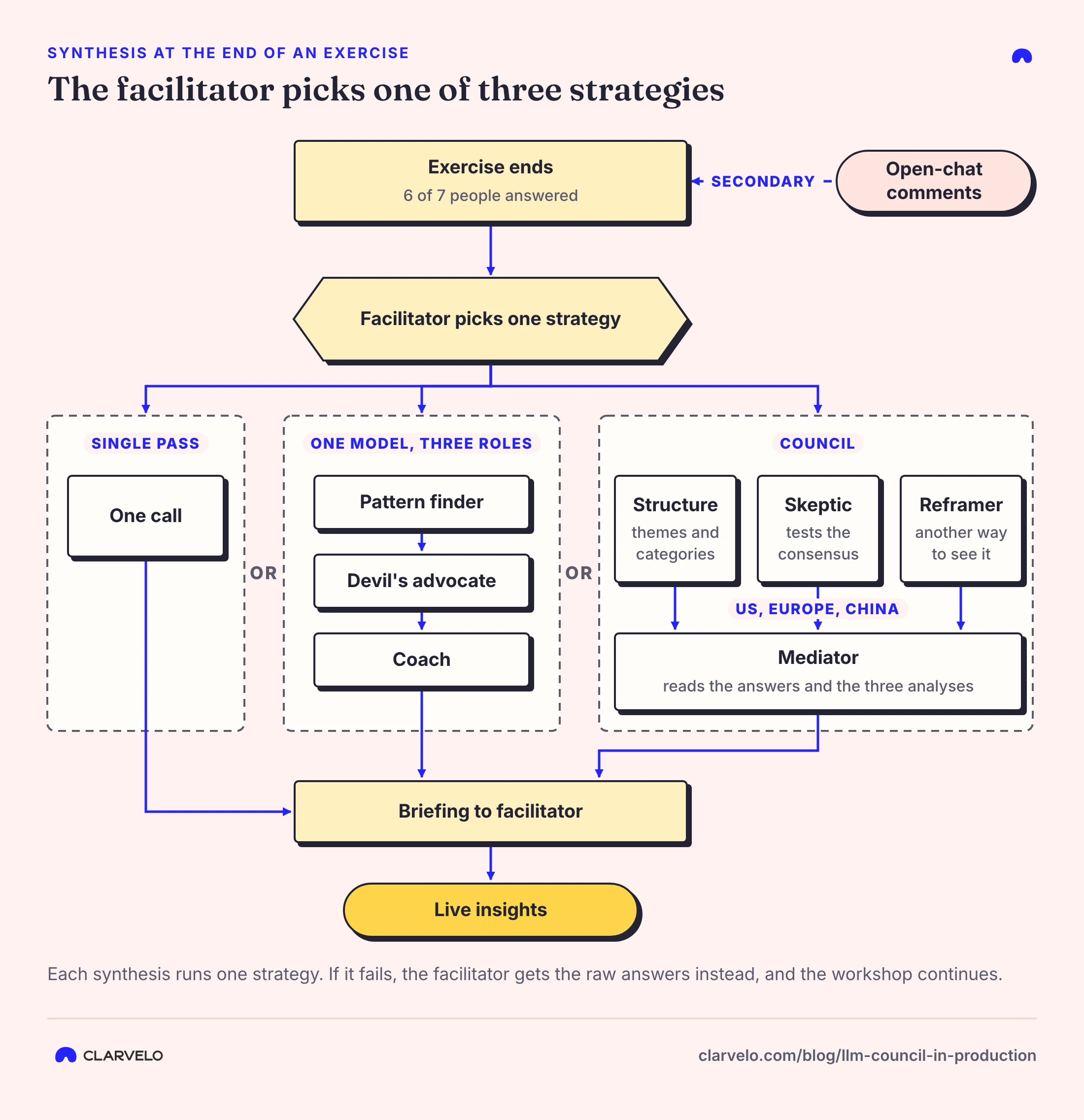
We do not run the council for every exercise. The facilitator chooses one of three strategies each time it asks for a synthesis. There is no global setting. It can also give a focus, such as areas of disagreement.
| Strategy | Model calls | Shape | Approx. cost per synthesis | When the facilitator uses it |
|---|---|---|---|---|
| Single pass | 1 | One call | Lowest (one call) | Simple or time-sensitive exercises, such as a check-in or a quick pulse |
| One model, three roles | 3 | Three calls in series | About $0.04 | Exercises that need a deeper read, when the room has a little time |
| Council of three models | 4 | Three calls in parallel, then one | About $0.06 | Ambiguous input, or a room with real tension or disagreement |
A fast single pass
One model reads the answers and writes a short diagnostic briefing. This is the default for exercises where the answers are simple, or where the room should not wait. Many exercises in a workshop are like this, for example a check-in at the start of a retrospective.
One model taking turns as pattern finder, devil's advocate and coach
The second strategy uses one model three times in a row, each time in a different role. First a pattern finder looks for themes and clusters. Then a devil's advocate looks for contradictions, missing voices and blind spots in those patterns. Last, a coach combines both into a briefing for the facilitator. Each turn sees the original answers and the notes from the earlier turns.
This idea comes from research on Solo Performance Prompting (SPP) by Wang et al. (2023), in which one model works through a task by talking to itself in several personas. In the paper, the model chooses its personas for each task. We use three fixed roles, because the job is always the same: read what a group said. The paper also reports that the benefit appeared in GPT-4 but not in smaller models such as GPT-3.5-turbo and Llama 2 13B. We take that as a warning: role-play works only with a capable model, and the three roles share the same weights and the same blind spots.
How our LLM council works: three models from three providers in three regions
The third strategy is our LLM council, which our code calls a council of experts. Three models run in parallel. Each comes from a different provider, and the three providers are based in the US, Europe and China. Each seat has a different job: one looks for structure and categories in the answers, one plays the contrarian, questioning the apparent consensus and looking for gaps, and one looks for a different way to frame the problem. A fourth call, the mediator, reads the original answers and the three analyses and writes the briefing. We ask the mediator to show where the experts agree and to explain where they disagree, not to pick a winner.
Why model diversity reduces shared blind spots
A model that checks its own work is a weak check. Research on LLM-as-a-judge (using a language model to grade or compare outputs) shows this clearly. Zheng et al. (2023) found that strong judges agree with human preferences more than 80% of the time, but also found position bias, verbosity bias and self-enhancement bias. Panickssery, Bowman and Feng (2024) found that LLM evaluators rate their own outputs higher than other models' outputs, even when human annotators rate the texts as equal. They also found that the more a model can recognize its own text, the stronger its self-preference.
We expect the same bias in synthesis, where it would show up as a model that agrees with its own first framing. In the single-model strategy, the devil's advocate argues against notes written by the same model, so it starts from the same assumptions. A council with different models starts from different assumptions.
The closest published result to our design is Verga et al. (2024), who replaced one large judge with a panel of smaller models from different model families. The panel did better than the single large judge, showed less bias toward any one model, and cost over seven times less. Our council follows the same reasoning: several smaller models that differ from each other, instead of one large model.
Diversity only helps if the members make different mistakes. Kim et al. (2025) measured how often language models fail in the same way. On one leaderboard dataset, two models agreed 60% of the time when both were wrong, and models from the same provider or with the same architecture were more correlated. This is why our three seats use three providers, not three models from one lab. We chose models developed by companies based in the US, Europe and China for the same reason: our bet is that these companies train on different data and make different alignment choices, so their defaults differ when they read a team's answers. The same paper also gives us a limit, which we cover below.
Within that rule, we tested candidate models on each seat's own job and gave each seat to the model that did it best. For the reframing seat, for example, we ran every candidate three times on the same answers. The model we chose found a different unstated assumption on each run, while one candidate repeated itself and another drifted off topic. One model wrote the sharpest reframings of all, but it already held another seat, so we passed it over to keep the three expert seats with three providers. When the best performer and the regional spread pulled in different directions, the regional spread won.
LLM council vs mixture of agents
The Mixture-of-Agents paper by Wang et al. (2024) is the best-known research version of this pattern. It stacks layers of models. Each model in a layer reads all the outputs from the layer before it, and a final model combines them. With open-source models only, their system scored 65.1% on AlpacaEval 2.0, against 57.5% for GPT-4o. Our council is a small two-layer mixture of agents: three proposers and one aggregator.
Multiagent debate by Du et al. (2023) is a different design. Several copies of one model answer, then critique each other over several rounds until they agree on one answer. That works for math and fact questions, where agreement is a sign of a correct answer. In a workshop, we do not want to manufacture agreement. If the people in the room disagree, the briefing should say so. For this reason our council runs one round and does not try to converge.
| Karpathy's LLM Council | Mixture-of-Agents | Multiagent debate | Clarvelo council | |
|---|---|---|---|---|
| Input | One person's question | One prompt | One question | Answers from a group, with counts |
| Members | Four models from four labs | Several models per layer | Copies of one model | Three models, three providers, three regions |
| Members see each other? | Yes, to rank answers | Yes, the layer before | Yes, every round | No, the mediator sees all |
| Ranking stage | Anonymous peer review | None | None | None |
| Rounds | One | Several layers | Several, until they agree | One |
| Final step | Chairman writes the answer | Aggregator writes the answer | Agreed answer | Mediator writes a briefing for the facilitator |
| Who decides | The chairman | The aggregator | The models | The mediator decides what the facilitator sees, and the facilitator decides what to do with it |
What it costs and how long it takes
The council costs about $0.06 per synthesis with four model calls. The single-model strategy costs about $0.04 with three calls. The single pass makes one call. These are our typical figures. Our usage records store the tokens and the cost of every synthesis call, tagged by strategy and by stage. That breakdown lets us see which seat costs the most and how often the council falls back.
For a sense of scale: a workshop that used the council at the end of each of five exercises would spend about $0.30 on synthesis. For comparison, Karpathy's default council makes about nine calls to frontier models per question (four answers, four reviews and one chairman call).
Latency works differently. The single-model strategy makes three calls in series, because each role needs the output of the one before it. The council makes four calls but only two steps in series: the three experts run at the same time, then the mediator runs. So the council costs more but is not necessarily slower. The slowest expert sets the pace of the first step. Each expert has a time limit, and when an expert passes it, the council continues without that expert. We timed this before we chose the council's models. Over repeated runs we compared several mixes of three providers, and kept the one with the best balance of speed and stability.
How failure is handled
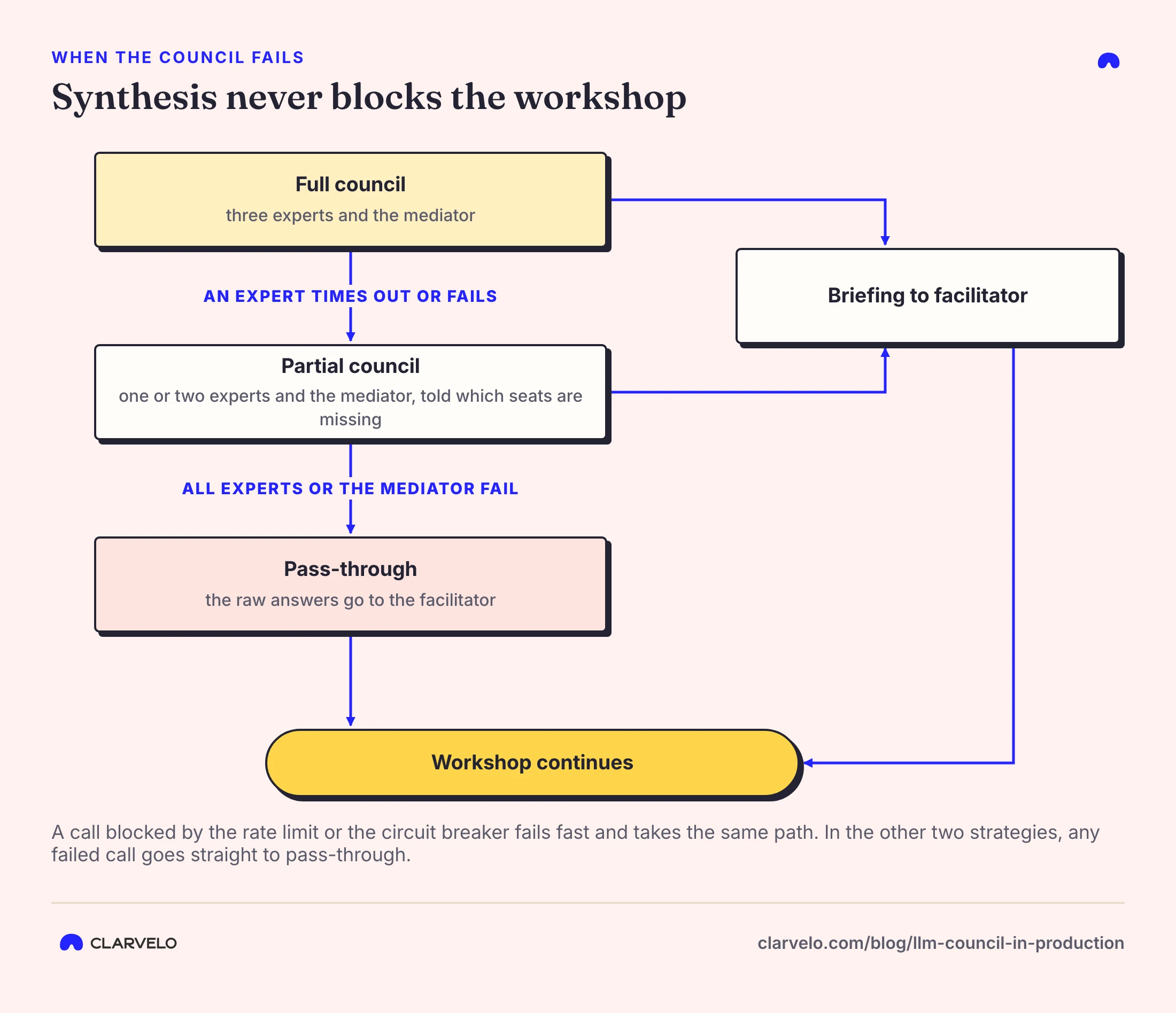
Our rule is simple: synthesis must never block a workshop. If any part fails, the session continues with less analysis.
| What fails | What happens |
|---|---|
| One or two council experts fail or time out | The mediator works with the analyses it has, and it is told which seats are missing, so it does not present two views as three |
| All three council experts fail | Pass-through |
| The mediator fails | Pass-through |
| Any turn of the single-model strategy fails | Pass-through, because each turn depends on the turn before it |
| The single pass fails | Pass-through |
| The rate limit or the circuit breaker blocks a call | That call fails fast, and the rules above apply |
Pass-through means the facilitator receives the raw answers from the exercise, unchanged, and makes sense of them in its own turn. The room may get a less considered summary, but the session keeps moving. Every synthesis records whether it fell back, so we can see how often it happens.
All synthesis calls go through one point in the code that applies two guardrails. A rate limit stops a burst of calls from becoming a burst of cost. A circuit breaker (a switch that stops calls after repeated failures) blocks further calls for a while when a provider looks down, so a workshop does not wait on calls that will fail anyway. Only signs of an outage trip the breaker. A rejected request points to a problem on our side, and it does not. Each council expert's call goes through the same point, so the limits also cover the three parallel calls.
Known limits
Cost and latency are the obvious limits. The council costs about 50% more than the single-model strategy and makes four calls instead of one. The facilitator uses it only when an exercise needs it, but that is a judgment the facilitator can get wrong.
A mediator can still smooth over dissent. One model writes the final briefing, and models like a tidy story. If one expert finds the minority view and the other two do not, the mediator can drop it. We ask the mediator to keep disagreement visible. In addition, the room still sees what people actually wrote, and the summary is never exported as a decision. But the risk is real, and the self-preference research above suggests that a mediator may also prefer the analysis that reads most like its own writing.
That risk is closer for us than for most councils, because our mediator runs on the same model as one of the expert seats. We chose it after testing several models as the mediator on our real synthesis path, comparing how fairly each briefing represented the three analyses, how specific it was, and what it cost. This model wrote the best briefings at a cost we can carry, and a cheaper model from a fourth lab wrote less pointed ones. We accepted the overlap and treat it as a known limit.
Diversity reduces shared blind spots, but it cannot remove them. Kim et al. found that larger and more accurate models make highly correlated mistakes even when they come from different providers and use different architectures. Three providers in the US, Europe and China buy us some independence, not full independence.
We tested each seat's candidates on speed, cost and the seat's own job before choosing the council's models, but we have not yet published a controlled comparison of the three strategies' quality on group input. Today the choice between strategies rests on the design reasoning and the research in this post. A proper evaluation, with real exercises and a known set of themes and disagreements for each one, is the next piece of work we want to do here.
Despite these limits, we think the council is worth its cost for the exercises that need it. A council of different models is the cheapest second opinion we know of, and in a workshop a second opinion is often what catches the view that only one person in the room holds. That is the core of what we mean by multiplayer AI: one AI that works for a whole group, not only for the person who typed.
Frequently asked questions
What is Karpathy's LLM Council?
It is an open-source web app by Andrej Karpathy that sends one question to several models through one API. Each model answers, then ranks the other answers with the authors hidden, and a chairman model writes the final reply. Karpathy built it as a Saturday project to compare models while he read books with them, and he does not plan to support it.
Is an LLM council better than a single model?
It depends on the task and on how different the members are. Research on panels of judges and on mixture of agents shows gains over one model, and research on self-preference shows why one model is a weak judge of its own work. But models from the same provider tend to make the same mistakes, so a council of similar models adds cost without much independence.
How much does an LLM council cost to run?
It depends on the models and the number of stages. Our production council makes four calls (three experts and one mediator) and costs about $0.06 per synthesis. A council with four frontier models and a peer-review stage, like Karpathy's default, makes about nine calls per question and costs more.
What is the difference between an LLM council and mixture of agents?
Mixture of agents is the research name for layers of models, where each layer reads the outputs of the layer before and a final model combines them. An LLM council is usually one layer of members plus a chairman, and Karpathy's version adds a stage where members rank each other. Our council is a two-layer mixture of agents with no ranking stage.
How do you build an LLM council?
Start with three or more models from different providers, because models from the same provider tend to make the same mistakes. Give each one a different job and run them in parallel, each with a time limit. Then give a final model the original input and every member's output, and ask it to write one answer that keeps the disagreements. Decide in advance what happens when a member fails, and record the cost of each stage so you can see what the council is worth.
Is a one-model LLM council skill as good as a council of different models?
It is cheaper and easy to set up, and role-play does help a capable model. But the roles share the same weights, so they share blind spots, and research on self-preference suggests the model will favor its own framing. We use one model in three roles for exercises that need a deeper read quickly, and different models when the room disagrees.
What makes a good LLM council prompt?
The structure matters more than the wording. Give each member a different job, not the same question three times. Give the final model the original input as well as the members' outputs, tell it when a member is missing, and ask it to report disagreement instead of choosing a winner.